
News from the Network
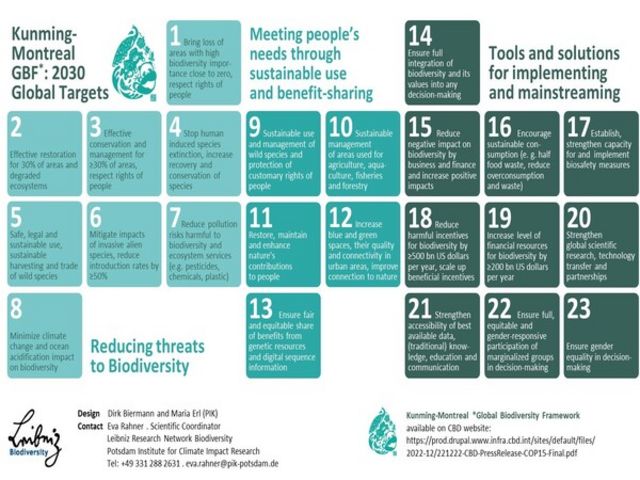
Overview chart of the 23 global targets to 2030 of the Kunming-Montreal Global Biodiversity Framework (UN World Conference on Nature 2022)
03/01/2023 · Leibniz BiodiversitätThe UN World Conference on Nature adopted 23 action-oriented global goals for biodiversity conservation by 2030. The Leibniz Biodiversity Research Network (Leibniz Biodiversity) has summarised these in an overview graphic. You can access the graphic via the link below and are welcome to use it under CC-BY-NC-ND. Please note that this graphic has not been authorised by the responsible bodies.
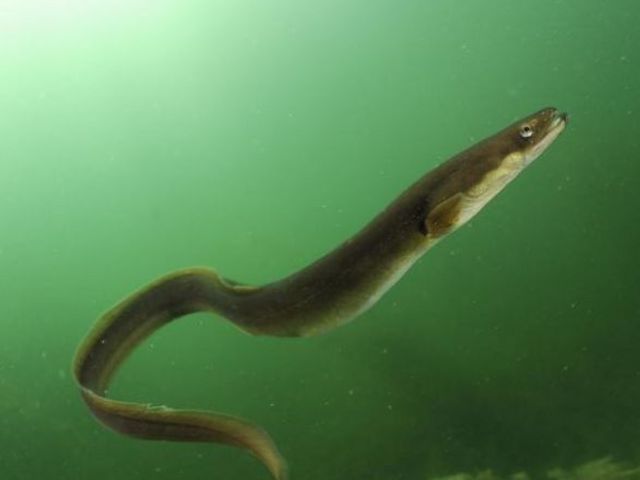
9 reasons why we humans urgently need freshwater biodiversity
02/09/2023 · IGBThe World Conference on Biological Diversity (CBD COP 15) has just made it clear how important the protection of biodiversity is for us humans. According to the final declaration - the Kunming-Montreal Global Biodiversity Framework - one goal is to maintain and restore the "functions and services of ecosystems". An international research team led by the United States Geological Survey (USGS) Climate Adaptation Science Center and the Leibniz Institute of Freshwater Ecology and Inland Fisheries (IGB) has worked out which ecosystem services depend on biodiversity in freshwater - and this is not just about edible fish and the recreational value of living waters. Health and genetic resources are also ecosystem services provided by water bodies and used by humans. Another example is the contribution to climate regulation, among other things through carbon storage and sequestration.
Soil sealing in rural areas as an underestimated factor in water quality degradation
01/20/2023 · IGB and SGNUrbanization goes hand in hand with a considerable sealing of soils. About 20 percent of the newly sealed area is not in urban areas, but in rural areas, according to the model calculations of a study by the Senckenberg – Leibniz Institution for Biodiversity and Earth System Research (SGN) and Leibniz Institute of Freshwater Ecology and Inland Fisheries (IGB). However, calculations of nutrient fluxes into water bodies have not taken these new sealings in rural areas into account, because these are often based on land use maps and consider urban areas. As a result, the nutrient loads of water bodies are systematically underestimated. Water quality suffers under sealing, but aquatic life is also affected: among invertebrates in particular, non-native species increase significantly and sensitive species decrease significantly, the study found.
![[Translate to english:] Sojabohnen](/fileadmin/_processed_/1/c/csm_Soja_ZALF_6b24cf5266.jpg "[Translate to english:] Sojabohnen")
An opportunity in climate change: Soy production to increase in Europe in the future
01/04/2023 · ZALFClimate change requires a rethink of crop production towards varieties and crops that are better adapted to heat and drought. Soybean is an arable crop that thrives in warm conditions and provides itself with nitrogen, an important plant nutrient that otherwise farmers would have to fertilize. A study published by the Leibniz Centre for Agricultural Landscape Research (ZALF) in the scientific journal "Global Change Biology" shows that in the long term, more and more arable land in Europe will become suitable for soy production. This effect exceeds the yield losses that are to be expected due to increasing heat and drought, especially in southern Europe. According to the authors of the study, this would enable the EU to do without a large proportion of soybean imports from Brazil and the USA in the future.
10 Must Dos from Biodiversity Science: Leibniz Research Network Biodiversity addresses policy-makers with concrete demands
12/05/2022 · Leibniz BiodiversityThe authors of 10 Must Knows from Biodiversity Science (2022, 10.5281/zenodo.6257527) developed their scientific findings further into 10 Must Dos from Biodiversity Research (10MustDos). These 10MustDos correspond to ten concrete recommendations for policy action that can be implemented in the short term. They are intended to serve as a guide for the 15th UN Biodiversity Conference in Montreal in 2022 and also to help in practical policy-making in Germany, Europe and worldwide by providing sound scientific findings to protect global biodiversity and stop the man-made extinction of species. The proposed solutions open up opportunities for action that are in line with the goals of the UN Decade for Ecosystem Restoration and feed into the 17 Sustainable Development Goals (SDGs) to be implemented by all nation states by 2030 to address the biodiversity, climate and equity crisis.
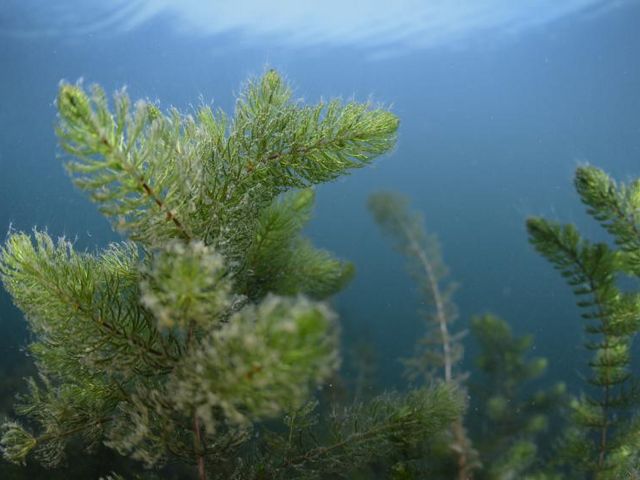
Climate change: More algae and fewer aquatic plants promote methane emissions
11/02/2022 · IGBIn recent years, submerged macrophytes have disappeared in many shallow lakes around the world, with more algae and free-floating plants growing instead. A Chinese team, in collaboration with IGB researcher Sabine Hilt, has shown in a large mesocosm experiment how heat waves, nutrients and pesticides promote algae growth and cause aquatic plants to dwindle. This shift in plant types may increase the total amount of greenhouse gas emissions from shallow lakes, as Sabine Hilt and Dutch colleagues demonstrated in another mesocosm experiment.
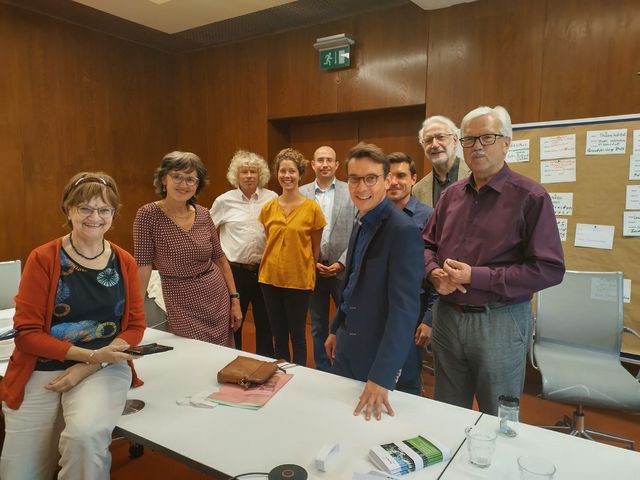
Appreciating biodiversity: Scientists explore how economic accounting can be ecologically modernized
08/19/2022 · IOER together with UFZ, IZT and VBAIntact ecosystems – such as clean, species-rich rivers or near-natural forests – are the subject of environmental reporting in Germany. Surprisingly, however, they scarcely play any role in national accounting or private sector accounting. This means that the manifold contributions of ecosystems to societal well-being and prosperity are underestimated while at the same time biodiversity is systematically neglected as the basis for nature’s sustainable services to society. In the Bio-Mo-D project, a research alliance is now exploring how corporate and national economic reporting can be expanded to include ecosystem services and biodiversity indicators. The aim is to provide business, political and social leaders with information to make ecologically sustainable decisions – and thus to ensure that sufficient value is placed on nature and biodiversity. The research alliance includes the Leibniz Institute of Ecological Urban and Regional Development (IOER), the Helmholtz Centre for Environmental Research (UFZ), the Institute for Future Studies and Technology Assessment (IZT) and the Value Balancing Alliance (VBA).
![[Translate to english:] PD Dr. Kirsten Thonicke und Eva Rahner vom PIK im Gespräch mit MdB Isabel Mackensen-Geis zu Wäldern](/fileadmin/_processed_/2/3/csm_Leibniz_im_Bundestag_MdB_Mackensen-Geis_31052022_1045928fe1.jpg "[Translate to english:] PD Dr. Kirsten Thonicke und Eva Rahner vom PIK im Gespräch mit MdB Isabel Mackensen-Geis zu Wäldern")
Leibniz in the Bundestag: Scientists talk to members of the German parliament about the "10 Must Knows from Biodiversity Science"
06/01/2022 · Leibniz BiodiversityAs part of "Leibniz in the Bundestag", three authors of the "10 Must Knows from Biodiversity Science 2022" spoke to members of the German Bundestag. Prof. Dr. Wolfgang Wende from the Leibniz Institute for Ecological Spatial Development (IÖR) spoke to MdB Karlheinz Busen (FDP) about the scientific findings and policy recommendations from the 10MustKnows with a special focus on the role of agriculture. PD Dr. Kirsten Thonicke and Eva Rahner from the Potsdam Institute for Climate Impact Research (PIK) talked to MdB Isabel Mackensen-Geis (SPD) about climate and biodiversity protection in the forest (see photo).